
No data centre in the Gulf has been publicly securitized yet as far as we can tell. That is the reason to pay attention. The region is building data centres faster than its banks can comfortably fund them, the rules for asset-backed issuance are being rewritten in Riyadh and Abu Dhabi, and the first operating assets are getting close to the point where a capital markets refinancing makes sense.
The Gulf is also the first region where data centres have been hit in a war. Any structure that comes to market will have to deal with that directly.
This article covers what data centre securitization is, where Gulf financing stands in November 2026, what a first deal would need to solve, and what to watch next.
What is data centre securitization?
Data centre securitization is the refinancing of operating data centres with bonds that are repaid from tenant lease payments. The owner transfers the assets, or the leases and security over them, to a special purpose vehicle. The vehicle issues rated notes to investors, and rent from the tenants pays interest and principal.
Two formats dominate. ABS deals usually sit on a master trust, so a sponsor can add new facilities and issue further series over time. CMBS deals usually finance a single asset or campus with a balloon maturity. The Structured Finance Association has a clear comparison of the two.
The market is young. The first US deal was a $900 million Vantage transaction in February 2018, and Europe followed in 2024 with a £600 million Vantage deal backed by UK assets, according to RBC Capital Markets. By 8 October 2026 Barclays counted $44.2 billion of data centre ABS and $22.4 billion of CMBS outstanding, figures cited in the CREFC data centre primer.
One point matters for everything that follows. Securitization is a takeout product. It refinances stabilized, leased, cash-generating assets. It does not fund construction.
What is happening in the Gulf?
Gulf data centres are being financed with bank loans and sovereign money today. The capital markets have not been asked yet.
The build-out is large. Saudi Arabia has about 410 MW of IT capacity and the forecast is to reach roughly 1 GW by 2030, according to Alvarez & Marsal. Humain, the PIF-backed AI company, is reported to be targeting more than 6 GW over the next decade. In Abu Dhabi, the first 200 MW phase of the 1 GW Stargate campus is under construction, Infralogic reports.
The debt so far looks like this:
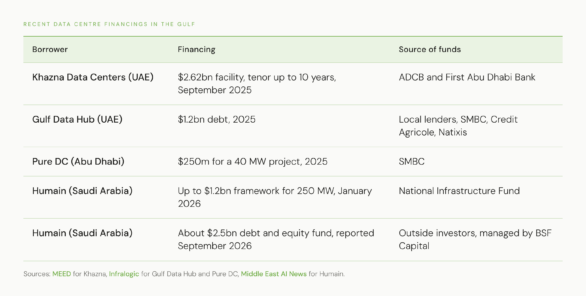
Sources: MEED for Khazna, Infralogic for Gulf Data Hub and Pure DC, Middle East AI News for Humain.
Every line in that table is a loan, a framework or a fund. None is a bond backed by leases. That is normal for a market at this stage and it is also where the pressure starts to build.
Why securitization is the logical next step?
Three things point the same way.
Bank balance sheets have limits. Alvarez & Marsal estimates that energizing half of Saudi Arabia’s announced pipeline by 2030 would need $14 billion to $32 billion of debt. That is more than Saudi banks have syndicated for this sector before, and it competes with a Vision 2030 project finance pipeline of $100 billion to $150 billion. Banks that want to keep lending need a way to recycle capital.
Developers now carry the debt. Capacity is increasingly built by specialist operators such as DataVolt, center3 and Khazna, and leased to the companies that use it. The balance sheet burden has moved from users to sponsors. A sponsor with ten campuses to build cannot leave ten-year bank debt sitting on the first one.
Investors want an exit. Infralogic quotes a large US infrastructure investor that has looked at Gulf data centres several times and passed each time, because it could not see a clear return plan or exit. A working refinancing market is a large part of that answer. In the US, the route from construction loan to ABS or CMBS takeout is well travelled. In the Gulf, it does not exist yet.
The rulebook is moving too. In April 2026 the Saudi Capital Market Authority consulted on amendments that would allow public offerings of asset-backed debt for the first time, with 5% originator risk retention, a mandatory credit rating and investor reports within 30 days of each distribution. The Saudi Real Estate Refinance Company launched the kingdom’s second RMBS in October, Enterprise reports. In the UAE, onshore rules have recognised true sale since 2023, although most deals are still structured through ADGM or DIFC, as the Chambers securitisation guide explains.
None of this was written for data centres. It builds the plumbing a data centre deal would use.
What a Gulf data centre deal has to solve
A first Gulf transaction cannot be a copy of a Virginia master trust. Four issues will shape it:
War risk. Iranian drones struck AWS facilities in the UAE and Bahrain in March 2026, days after the war began. By August at least five data centres in the region had been attacked, CNN reported, and insurance had become far more expensive where it could be bought at all. Fresh attacks on Bahrain were reported as recently as mid-November. Rating agencies have years of data on power outages and tenant churn. They have none on missile damage to a hyperscale campus. Expect geographic diversification tests, long liquidity reserves, explicit insurance covenants and conservative leverage.
Tenant concentration. Many Gulf facilities are leased to one or two tenants, often government-linked. A sovereign-linked off-taker is good credit. It also means the bond rating is tied closely to the sovereign, and the pool lacks the tenant diversity that US ABS investors are used to.
Format. A large part of the regional investor base buys sukuk. Lease-based cash flows suit an ijara structure well, so the first deal may be an asset-backed sukuk and not a conventional note. Whether it is issued onshore in Saudi Arabia, through ADGM or DIFC, or as a 144A deal for US investors will decide who can buy it.
Technology and timing. AI-dense halls age faster than the buildings around them, and US investors are already pushing back. CREFC data shows US data centre ABS and CMBS issuance down about 20% over the three months to October 2026 compared with a year earlier. A Gulf sponsor would be coming to a market that has become more selective.
There is one more requirement, and it is the one we see underestimated most often. Securitization investors expect loan-level or lease-level data, a waterfall that runs correctly every period and reports that arrive on time. The Saudi draft rules write that expectation into regulation. A sponsor whose lease data lives in spreadsheets will find the reporting harder than the structuring.
Why pay attention, and what to watch in 2027
The first Gulf data centre securitization will set the template for every deal after it. Advance rates, reserve sizing, how war risk is treated, what the investor report contains. Whoever is in the room for that deal shapes a market that could run to tens of billions of dollars.
It matters to different people for different reasons:
Regional banks hold the construction and term loans. Securitization, whether true sale or synthetic, is how they free capital for the next campus.
Sponsors and developers need a refinancing route in the plan from day one. Alvarez & Marsal makes the same point about pricing the balloon up front.
Investors get contracted, long-dated infrastructure cash flows with sovereign-linked tenants, at a spread that reflects real geopolitical risk.
Arrangers and service providers have a short window to build the capability before mandates are awarded.
Five signals are worth tracking:
- Final Saudi CMA and Saudi Exchange securitization rules. The consultations closed in mid-2026 and the final text is still pending.
- The first Gulf operator to refinance a stabilized campus in the bond or sukuk market in any format.
- How Humain’s planned fund structures its debt, and whether DataVolt’s project financings include a capital markets takeout.
- Whether war risk insurance for data centres becomes available at a price lenders accept. This depends on a durable settlement with Iran.
- The health of the US market. If US data centre ABS spreads keep widening, a debut Gulf deal becomes harder to place.
Our view is that the first transaction could well be a privately placed, sukuk-compatible deal from a sovereign-linked sponsor and not a public 144A issue, although the format will depend on how the rules and the security situation develop. The timing is hard to call, but what seems clear is that debt on this scale will need a refinancing route.
Frequently asked questions
Has a data centre been securitized in the Middle East?
Not publicly, as of November 2026. Gulf data centres are financed with bank loans, sovereign-backed frameworks and private funds. The largest disclosed facility is Khazna’s $2.62 billion loan from ADCB and First Abu Dhabi Bank.
How big is the global data centre securitization market?
Barclays counted $44.2 billion of data centre ABS and $22.4 billion of CMBS outstanding on 8 October 2026. Almost all of it is backed by US assets. Europe has seen a handful of public deals since 2024.
Why would Gulf operators securitize if sovereign funds can pay?
Sovereign capital is large but it is not free, and it is being asked to fund many priorities at once. Securitization lets an operator refinance a finished, leased campus at a lower cost and reuse the equity and bank lines for the next build.
Could a data centre securitization be Sharia-compliant?
Yes. Data centre income is lease income, which fits an ijara-based asset-backed sukuk. Saudi Arabia’s draft securitization rules are explicitly aimed at deepening the sukuk market.