
A securitization transaction is signed once and then run for years. Every month or quarter, someone has to pull the loan data, run the waterfall, test the triggers, top up the pool and send the reports. For many teams that work still happens in spreadsheets.
Securitization software exists to take over that cycle. The term is used loosely, though. It covers everything from cash flow modeling tools to full platforms that run a deal from portfolio selection to regulatory reporting, and vendor pages tend to describe all of them in the same words.
This guide is for the people who operate transactions: structured finance, treasury, risk and reporting teams at banks, captive finance companies and other originators. It explains what the software does, how the categories differ, what changes between true sale and synthetic deals, and what to ask a vendor before you commit.
What is securitization software?
Securitization software is the system that runs a securitization once the deal documents are signed. It selects and tracks the asset pool, calculates the payment waterfall, tests the triggers, handles replenishment, and produces the investor and regulatory reports, with a record of how every number was reached.
That’s a narrower definition than most you’ll find, and it’s narrow on purpose. The term gets used for at least four different kinds of tools, from cash flow modeling packages to loan servicing systems with a securitization module added on. They solve different problems for different teams.
What securitization software does
Every securitization repeats the same cycle, usually monthly or quarterly, for the life of the deal. Securitization software runs that cycle from the loan-level data to the final report. The work breaks down into six jobs.
Portfolio selection. Before closing, the software applies the eligibility criteria and concentration limits to the candidate pool and shows which assets qualify. In a spreadsheet that can take days of filtering. It should take minutes.
Structuring. Tranches, credit enhancement, reserve accounts and triggers are modeled, adjusted and rerun as the deal takes shape.
Waterfall calculation. On each payment date the software allocates collections and losses to the tranches in the order the documents prescribe. This is the heart of the deal, and it’s where errors cost the most.
Replenishment. In a revolving deal, repaid assets are replaced with new ones. Each new asset has to pass the eligibility tests, and the pool has to stay compliant after the top-up.
Reporting. Investors, trustees, rating agencies and supervisors all want the same deal described in different formats. In the EU that includes the ESMA disclosure templates and, for banks, the COREP securitization templates.
Audit trail. Every calculation is logged with its inputs, the user and the time, so any figure in any past report can be explained later.
The six jobs matter less than the links between them. A reporting tool that can’t see the waterfall, or a waterfall model that can’t see the replenishment, hands the reconciliation back to your team. That reconciliation tends to be where the manual hours go.
The four types of securitization software
Search for securitization software and you’ll find tools that barely overlap. Most fall into one of four groups.
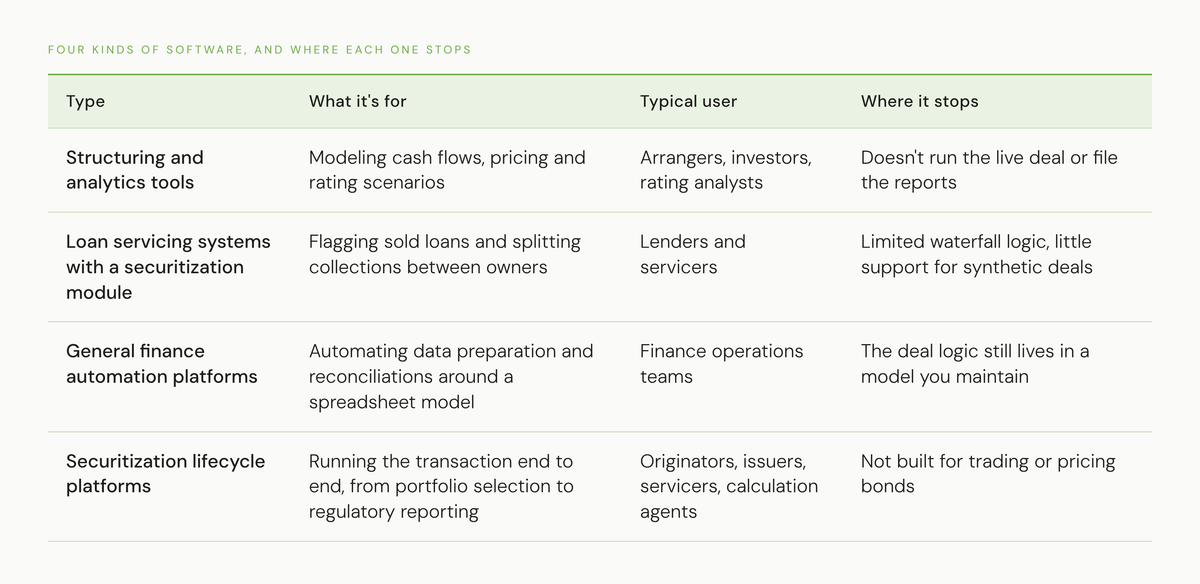
None of these is the wrong answer in general. An investor valuing a bond portfolio needs analytics, not a waterfall engine. But if your problem is a reporting run that takes two weeks and depends on one person’s spreadsheet, a lifecycle platform is the category you’re shopping in. The rest of this guide is about that category.
True sale and synthetic deals need different things
Most descriptions of securitization software assume a true sale. Assets move to a special purpose vehicle, which issues notes backed by the cash flows. But a growing share of bank issuance is synthetic. The loans stay on the balance sheet and the bank buys credit protection on a tranche of the portfolio, usually to achieve significant risk transfer and release regulatory capital. The IACPM’s annual bank survey put 2025 volume at €30 billion of tranches, 20% more than the year before, protecting €378 billion of loans.
The two structures stress the software in different places.
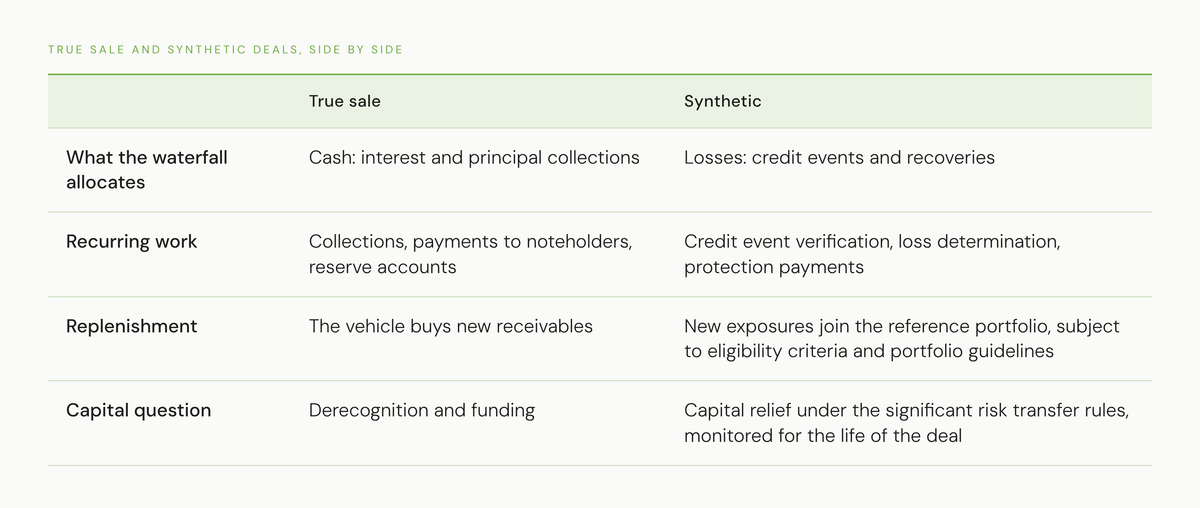
A platform designed around cash waterfalls doesn’t automatically handle loss allocation, initial and final loss claims, or the capital calculations a risk transfer deal depends on. If you run both types, or expect to, check that one engine covers both. Otherwise you end up with two systems and a spreadsheet in between.
Build, buy, or outsource?
There are three ways to get the work done, and most institutions have tried at least two.
Build in-house. A spreadsheet model, or a custom system built by your own IT team. It fits your first deal perfectly. The trouble starts with the second and third, when each new structure means new development and the knowledge sits with a few people.
Outsource. A third-party calculation agent or service provider runs the numbers for a fee. It works well for a single transaction. You pay again for each deal, though, and you depend on someone else’s timetable when a regulator or an investor asks a question.
Buy a platform. The commitment is bigger up front and usually, the cost per deal falls as volume grows. Implementation should be measured in months. It makes most sense for repeat issuers, and for first-time issuers who already know the second deal will be coming at some point.
“Once the deal logic lives in software, three things change,” says Andras Vajda, founder and CEO of iconicchain. “The calculation runs the same way every period. A new transaction reuses what you’ve already set up. And when an investor or a supervisor asks where a number came from, you can show them in minutes.”
A rough rule: one static deal can be handled with any of the three options above. A program of deals, or anything revolving, is where spreadsheets and per-deal fees stop scaling and you should consider investing in a platform.
Eight questions to ask a securitization software vendor
Feature lists look alike. These questions separate the platforms.
- Which deal types are live in production today? Ask about true sale, synthetic, ABCP and covered bonds separately. “Supported” and “live with a client” are different answers.
- Is a new deal configured or coded? If every transaction needs development work, you’ve bought a services contract.
- How is replenishment handled? Ask to see the eligibility and portfolio tests run on a real top-up.
- Which regulatory reports come as standard? Name the ones you file: ESMA templates, COREP, investor reports in each investor’s format.
- Can you replay a past period? You should be able to reconstruct any historical figure with the data as it stood that day and see what changes downstream when a period is corrected.
- How does data get in and out? Look for standard interfaces to core banking, loan and risk systems, not a custom integration project.
- Where can it run? On-premise, private cloud and public cloud matter to different IT and security teams.
- How long until the first deal is live, and who else has done it? Ask for a named reference with a similar structure.
Frequently asked questions
What is securitization software used for?
Securitization software is used to administer a securitization transaction after closing. It selects and monitors the asset pool, calculates the waterfall, manages replenishment, and produces investor and regulatory reports. Banks, captive finance companies, servicers and calculation agents use it to replace spreadsheet models and manual reconciliations.
Who needs securitization software?
Any institution running more than one transaction, or a single revolving one, will feel the need. Typical users are structured finance, treasury, risk and regulatory reporting teams at originators, plus servicers and calculation agents acting for several issuers.
Can securitization software handle synthetic securitization?
Some platforms can, many can’t. Synthetic deals allocate losses instead of cash, and need credit event tracking, loss determination and capital relief calculations. Ask a vendor whether synthetic transactions are live in production, not only on the roadmap.
Is securitization software the same as a cash flow model?
No. A cash flow model projects how a deal might perform, and is used for structuring, pricing and rating. Securitization software calculates what the deal actually did each period and reports it. Many teams use both.
How long does securitization software take to implement?
For a lifecycle platform, expect months, not years. The timeline depends mostly on how clean the loan-level data is and how many systems feed it. An in-house build usually takes a good deal longer.